Showing posts with label Great Expectations. Show all posts

Sunday, 21 June 2020

(Not Really a) Review: The Five Most Overrated Novels

After many weeks of struggling I've finally given up on War and Peace. I made it to chapter forty-seven. Honestly I shouldn't have bothered reading forty-seven sentences of it, let alone chapters. So, inspired by that disaster, I've made a list of the five most overrated novels I've suffered through.


Already reviewed here. From what I've seen, Leo Tolstoy either wasn't a good author, or the English translations of his novels do him a disservice. After being bored to tears by both Anna Karenina and War and Peace, I'm inclined to think it's the former.


Already reviewed here. Unlike the other examples on this list, Great Expectations is actually a good novel. It's just not as good as some people claim. And it's certainly not the best of Dickens' works.


Already reviewed here. The Turn of the Screw is the least frightening, most boring horror novel I've ever read. And it drags on for aaaaaaaaaaaages. It can't decide if it wants to be a novel or a short story, and only succeeds in being too short for one and too long for the other.


I can sum The Great Gatsby up in one word: Yawn. Heavy-handed symbolism, threadbare plot, revolting characters, interminable dullness... In short it has everything I don't want in a novel. Of course, those flaws are probably the reason it's considered a classic, because some people believe only the most boring books ever written should become classics.


Middlemarch was one of the books I read out of morbid curiosity rather than interest. The miniseries adaptation was so bad that I thought the book had to be better. It isn't. If anything it's worse. Nothing ever happens in the entire sorry saga. Chapter after chapter it stumbles along without even trying to keep the reader's attention. Eventually I gave up in despair.

(Of course there are many more novels I consider overrated, but these are the five that immediately spring to mind.)

Sunday, 3 February 2019

Review: Great Expectations (2012)

Would you believe this is the fiftieth review on this blog? (Counting reviews split into two parts as one review, that is.)

For some reason someone decided to make a film of Great Expectations a year after a miniseries was made of it. What's stranger is the BBC was involved in making both versions.

I vastly prefer the 2011 series' opening to this one. This picture looks like the cover of a thriller novel, not an adaptation of a classic.

Adapting Charles Dickens' novels into films rarely works. They're so long and complicated that you have to cut practically everything except the main plot. So I knew before I watched this that a lot of the book would be missing.

I watched it immediately after the 2011 miniseries, so -- bizarrely -- I found I kept comparing this adaptation to that one instead of to the book. Like my review of the miniseries, this will mostly be a rambling list of things I did or didn't like.

Recognisable actors include:
Helena Bonham Carter (the Fairy Godmother in Cinderella 2015) as Miss Haversham
Holliday Grainger (Anastasia in Cinderella 2015) as Estella
Ralph Fiennes (Voldemort in Harry Potter) as Magwitch
Robbie Coltrane (Hagrid in Harry Potter) as Jaggers
Jason Flemyng (Azazel in X-Men: First Class) as Joe
Jessie Cave (Lavender Brown in Harry Potter) as Biddy

Like all versions of Great Expectations, the story starts with Pip meeting Magwitch. Then he goes to visit Miss Haversham and meets Estella... and Herbert. I don't remember Herbert finding Pip hiding under a carriage in the book, but it makes their fight a little bit more understandable than Herbert just demanding to fight Pip.

Miss Haversham

Young Estella and young Pip

The film includes Biddy! I was disappointed the series left her out. And it shows her grandmother's "school", and her teaching Pip to read!

Mr. Jaggers' introduction is odd. Why was he lurking in the shadows watching Estella and Pip? He's supposed to be mysterious and menacing, but not that creepy!

Estella teaching Pip to dance is unexpected, but surprisingly cute for these two. Naturally Miss Haversham decides to ruin everything by telling Pip not to visit any more.

The story jumps forward several years to Jaggers' visit and Pip learning about his great expectations. So off he goes to London. The film depicts London as much dirtier and more chaotic than the series does, with more butchers cutting up pieces of meat and more animal blood (at least, I hope that's animal blood) on the ground.

Like the series, the film shows the crowds of people waiting to see Jaggers. Pip and Wemmick's conversation about the casts of criminals' faces and the criminals' property is both close to the book and a fine example of black comedy.

Pip meets Herbert again, and becomes more and more arrogant now he has his fortune.

Pip

Herbert

Pip is still convinced that Miss Haversham is his benefactor, so he asks Herbert for more information about her. In this version we get a flashback to Miss Haversham's ill-fated wedding, and how she learnt Compeyson had jilted her. I'm not a fan of the way this scene is filmed. It's so blurry and distorted that the characters look like they're seen through a funhouse mirror. Why does "flashback" equate to "blurry" in so many directors' minds? It defeats the purpose if the viewers can't see things clearly.

There's a rather odd scene of Pip and Herbert going to a club where the members are... having a food fight? I don't remember anything like that in the book. But the film atones for that weirdness by including Wemmick's Aged Parent, and their habit of firing a cannon.

Pip visits Miss Haversham and meets Estella, who's now going to London. Why on earth did they have Estella walking on top of barrels? While in a long dress? I spent that whole scene expecting her to trip and fall.

Estella

My favourite line in the film is Mr. Jaggers' remark when he sees the amount of bills Pip has run up. "I suspected you would go wrong, Pip, but really, you are excelling yourself." That perfectly describes Pip's behaviour in London.

Estella gets engaged to Drummle, in spite of Pip's attempts to make her see reason. His "what do you think you're doing?" speech to her in the garden is the only time in the film he's shown any common sense. But Estella -- who has seen how Drummle behaves towards her -- doesn't listen. What an idiot.

After this Pip goes home -- to a house that's much grander in the film than in the book -- to find Magwitch. This scene is surprisingly eerie, even more than in the book. Pip doesn't cope well with learning the truth about his benefactor.

Pip and Magwitch

Miss Haversham's death is gruesome in all versions, but this one goes further and shows us glimpses of the aftermath *shudders*

Pip and Herbert try to get Magwitch out of England. Unfortunately, Compeyson and the police follow them. The film has a frightening scene of the steamship wheel running over Magwitch and Compeyson, and smashing the boat that Pip is in. Then there's Magwitch's death, which is just as sad here as in the series.

The film includes Joe paying Pip's debts and staying with him while he's ill! It improves on the series in that, at least. And then there's the final conversation between Pip and Estella. I'm still far from convinced that they would be happy if they married, but I get the impression that the film's version of them wouldn't be completely unhappy. That's probably the closest Great Expectations will ever get to a relatively cheerful ending.

The surprisingly sweet ending to a surprisingly good film.

Overall, the film is a pretty decent adaptation that in some ways is more faithful to the book than the series. But at the same time it's still rushed and trying to adapt a reallllly long book into two hours. It has its good moments and it has its flaws, but overall I think the good moments outnumber the flaws.

Is it available online?: No, I don't think so.

Rating: 6/10.

Wednesday, 23 January 2019

Review: Great Expectations (2011)

Great Expectations has never been one of my favourite Dickens novels, as you'll know if you've read my review of the book. But BBC period dramas are generally good (Bleak House, Pride and Prejudice 1995, Our Mutual Friend...), so I decided to watch this adaptation.


This is a three-episode miniseries adaptation of the novel. I'd like to know who thought adapting a Dickens novel into three episodes was a good idea. Nicholas Nickleby (2001) just about gets away with two episodes, but all Dickens' works post-Barnaby Rudge are too long and too complicated to fit into anything less than five episodes. Remember how Our Mutual Friend (1998) had to remove subplots and characters to squeeze the story into four episodes? Filmmakers (and series-makers) should really have learnt by now that Dickens adaptations need to be long, or a whole lot ends up cut.

Because there are only three episodes, I decided it wasn't worth splitting this review. So expect a long, rambling review full of remarks on things I liked, didn't like, or just noticed particularly.

I only recognised a few actors:
Gillian Anderson (Lady Dedlock in Bleak House 2005, and Lily in The House of Mirth 2000) as Miss Haversham
Ray Winstone (voice of Mr. Beaver in The Lion, the Witch and the Wardrobe, and Mac in Indiana Jones and the Kingdom of the Crystal Skull) as Magwitch
Vanessa Kirby (Princess Margaret in The Crown) as Estella
David Suchet (Melmotte in The Way We Live Now) as Jaggers
Harry Lloyd (Young Steerforth in David Copperfield 1999) as Herbert

From the opening scene it's obvious that visually, as well as thematically, this is going to be one of the darkest BBC period dramas. At first I wondered if it was in black-and-white. Nope, it's in colour, but it manages to make Little Dorrit look cheerful and brightly-coloured in comparison.

At first it looks like it's going to start the same way as the book: Magwitch finding Pip in the churchyard. But instead Pip leaves the churchyard, and Magwitch... jumps out at him from under a bridge? What? Then there's an unexpectedly violent scene of Magwitch trying to drown Compeyson in the marsh. This doesn't happen in the book, so its presence here serves no purpose beyond making the series even darker.

Young Pip and Magwitch

Anyway, Pip meets Magwitch and steals a file for him, then the soldiers recapture Magwitch and Compeyson, another escaped convict. Then Pip is invited to visit Satis House, where the mysterious Miss Haversham and Estella live.

Miss Haversham

Young Estella

What on earth is up with that cabinet of butterflies? I don't remember anything in the book about Miss Haversham's brother collecting butterflies. It feels like a heavy-handed attempt at symbolism, especially Miss Haversham's remarks about "stabbing beauty in the heart". And then there's Estella calling Miss Haversham "Mother". Umm... I'm pretty sure that never happened in the book. Estella is Miss Haversham's ward, which isn't quite the same as an adopted daughter, and she wasn't raised as her daughter.

The interiors of Satis House are very well done. Extremely creepy, covered in cobwebs, falling apart, exactly like in the book. Of course, in the book there were more wedding decorations and fewer stabbed butterflies, but I'll try to overlook that. We do eventually see the wedding decorations, so at least they didn't forget them entirely.

Some of the interiors, including the decaying wedding decorations.

Pip keeps visiting Miss Haversham, to the annoyance of her relatives, the Pockets. While at Satis House he meets Jaggers, Miss Haversham's lawyer, and Herbert, his future best friend. And, of course, he's starting to fall in love with Estella.

One of the weirdest scenes in the series is Miss Haversham's... tantrum? I really don't know what else to call it. She goes from speaking calmly like she always does to almost crying and then to screaming about her relatives like an angry teenager. When did that happen in the book?

After this Miss Haversham tells Pip not to visit any more and arranges for him to become his uncle Joe's apprentice. We get two unnerving scenes in fairly quick succession, and neither was in the book. One is between Pip's sister and Orlick, foreshadowing Orlick's murder attempt, and the other is between Miss Haversham and Estella, showing plainly how Miss Haversham is manipulating and emotionally abusing Estella. Then Joe and Pip go home... to find Pip's sister has almost been murdered.

Years pass. Pip, now grown up, goes to visit Miss Haversham again. He meets Estella, also grown up, and -- idiot that he is -- falls in love with her. Episode one ends when Jaggers arrives to tell Pip about his mysterious benefactor and his great expectations. So off Pip goes to London, thinking Miss Haversham is his benefactor.

Pip and Estella as adults

Episode two starts with Pip in London, meeting Mr. Jaggers again. A lot of this is lifted straight from the book -- the crowds waiting to see Jaggers and the gruesome heads on the wall especially. Then Pip moves into his new lodgings and meets Herbert again. I don't remember Herbert teaching Pip to dance in the book, but it's one of the few funny and relatively light-hearted scenes in this series, so I don't mind too much.

Jaggers

Herbert

In this version Herbert has been kicked out of his family because of the girl he loves. Er... what? When did this happen in the book? The Pocket family don't really have much to do with the plot, but if the director didn't want to include them, he could have just left them out. 

Pip gets to demonstrate how his new wealth is changing him for the worse. Joe comes to visit him, and Pip is ashamed and embarrassed to see him. Great way to repay the man who helped raise you and who was always kind to you, Pip! 😠 Then shortly afterwards, Pip decides to do something good with his money and arranges for Herbert to get a job. So nice of you to care about your friend and not your uncle, Pip!

Miss Haversham asks Pip to escort Estella to where she'll be staying in Richmond. At the house in Richmond Pip and Estella meet the coarse, brutish Bentley Drummle. There's a certain scene and some crude dialogue that isn't in the book, and therefore has no business being in the series.

Drummle and Estella.
(I keep thinking that's a blood-stain on Estella's dress. Perhaps that's what the costume designer intended.)

This Miss Haversham is much more... short-tempered? Prone to mood-swings? -- than her book counterpart. In addition to her earlier tantrum, there's a scene where she goes from asking Estella about her life in London to yelling at Pip. It shows how mentally unstable she is, but I was expecting her to be coldly arrogant like in the book, so at first I didn't know what to make of this behaviour. I still don't know, actually.

Almost forgot to mention that equally odd scene where Pip and Estella kiss while standing in a river. Huh? Setting aside the sheer weirdness of that scene, this series is set in a time when ladies never showed their legs in front of men. Ever.

Magwitch reappears, in very odd circumstances. Instead of Pip seeing him on the stairs and letting him in the door, he lets himself in while Pip is sleeping. And then he empties a sack of paper all over the carpet, while saying it's Pip's fortune and he's his benefactor? Who thought this was an improvement on the book's version of this scene?

Magwitch and Pip

In episode three, Pip tries to cope with Magwitch's revelation. At first he refuses to believe it, in spite of Herbert's protestations. Then he goes to confront Miss Haversham... and learns Estella is engaged to Drummle. Estella's decision makes even less sense here than in the book. She's seen what a jerk Drummle is, she has no need to get married to anyone, and Miss Haversham raised her specifically to break men's hearts which would be harder to do when she's married. So why on earth did Estella choose to marry him, and why did Miss Haversham go along with this? 😕

A reward is offered for Magwitch's recapture. Pip reluctantly agrees to help get him out of the country. Like in the book, this is the most interesting part of the story.

Estella has married Drummle, meanwhile, in spite of her own objections. Her husband won't let her answer Miss Haversham's letters. The scene of Miss Haversham crying and shouting Estella's name reminds me a lot of a similar scene in Bleak House (the novel, not the series). This scene wasn't in the book, if I recall, so maybe that was an intentional reference?


In this version we see Orlick and Compeyson plotting together. For some reason the director changed Molly's backstory. Instead of murdering a woman she hated, Compeyson tried to rape her and he framed her for attempted murder after she escaped. I'm not sure what to think about this change. On the one hand it makes Molly more sympathetic, but on the other, I tend to take a dim view of unnecessary differences from the book.

Orlick and Compeyson. Ugh.

Miss Haversham's death is slightly different here, and it makes her look like an absolute idiot. Who throws burning paper on the floor when they're wearing a long dress? And who just stands there after they catch fire and don't even try to beat it out?

A disaster waiting to happen. (I spent this whole scene shouting "Move away from the fire, you idiot!")

Pip tries to get Magwitch to safety. The plan fails, and like in the book it ends with Compeyson and Magwitch both dead. Good riddance to Compeyson, but I cried at Magwitch's death.

😭

Pip and Wemmick at Magwitch's grave.

The series doesn't include Pip falling ill and Joe nursing him back to health. (Guess they were running out of time 🤷) It does include Joe paying Pip's debts, though, so I can sort of forgive them for this omission.

Estella's husband has died, so she returns to Satis House. Pip goes to visit her. The series ends with a surprisingly sweet scene of the two of them.


So, what's my overall opinion? ...Good question. It changed with almost every scene. I like Joe and Herbert in most versions, and I like this version of Magwitch, Wemmick, and Miss Haversham (once I got used to Gillian Anderson's acting choices). Pip swings between being more likeable than his book counterpart, and a spoilt brat who sets my teeth on edge. Estella is... well, she didn't leave much of an impression, but at least she didn't drive me up the wall quite as much as book!Estella. In this version we get to see how miserable she is in her marriage instead of hearing about it second-hand, which made me feel more sorry for her than I did when I read the book.

One thing this adaptation does really well is visuals. The marshes are as gloomy and depressing as in the book, and Satis House is shown in all its decaying glory.

I suppose it's best described as "a decent, if rushed, adaptation with some very good moments".

Is it available online?: Yes, on Dailymotion. The link goes to episode 1, but the other episodes are available there too.

Rating: 6/10.

Wednesday, 9 January 2019

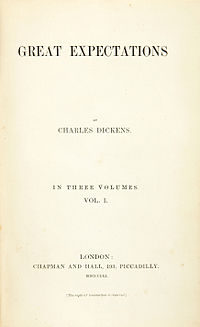
Review: Great Expectations (novel)

As a child I once sat through an incredibly boring black-and-white film, with a plot I didn't understand and could barely follow. So it's really not surprising that it took years before I decided to read the book that film was based on.


Great Expectations is Charles Dickens' thirteenth novel, published in 1861. It revolves around Pip as he grows up and finds that an anonymous benefactor has given him money.

This is one of Dickens' best-known, most-read novels. Oddly, it's one of his least Dickensian works. Pip, instead of being a good-hearted, decent character like Nicholas Nickleby or Amy Dorrit, grows up to be a selfish, arrogant jerk who doesn't want anything to do with his poor but kind uncle Joe. Estella, instead of being a typical Dickens love interest, is a cold and cruel brat who makes men fall in love with her then breaks their hearts. There is a revelation about a character being secretly related to two other characters, but it has virtually nothing to do with the plot, and only one of the characters involved ever learns the truth.

Most people are of the opinion this is one of Dickens' best works. I'm afraid I disagree. All of his novels have dark moments, but this one is unrelentingly dark from the opening scene in a graveyard to the misty, late-night (and decidedly ambiguous) epilogue. Maybe it's an after-effect of trying to watch the 1946 film at the age of about five, but Great Expectations has never been on my list of "Dickens novels I love".

That's not to say I hate it. It's a fascinating and depressing look at how riches corrupt, and there are some moments of humour (mostly black humour, but that's par for the course with Dickens). There are even some likable characters. The problem is, they aren't the main characters.

The main characters are among the most infuriating people I've ever read about. Estella has virtually no personality beyond constantly tormenting men who fall in love with her, and Pip is one of the many characters I really want to punch. Seriously, Pip? You abandoned Joe and Biddy, who had always been kind to you, for who you thought was Miss Haversham, who never saw you as anything but a way to annoy her relatives? And then you fell in love with Estella, when common sense and even Estella herself warned you this was a terrible idea? What sort of idiot are you? 😒

Luckily, once Magwitch appears on the scene (again) the story stops being about just Pip and Estella, and becomes much more interesting. And unbelievable though it seems, Pip becomes less obnoxious and I was actually able to sympathise with him. My heart was in my mouth during the attempted escape-by-boat, and I cried when Magwitch died 😢 After this, Pip finally realises how horrible he's been and he tries to make amends. That leads us to one of the most vague and unsatisfying endings Dickens ever wrote.

Why on earth do Pip and Estella just happen to visit the same place at the same time after not seeing each other for eleven years? All right, so it isn't the most unbelievable coincidence in a Dickens novel, but still! And are we supposed to assume they get married afterwards? I have strong doubts about how happy they'd be together. Dickens' original ending, where Pip learns Estella is happily remarried, would have been more depressing but probably more fitting.

Overall, Great Expectations is one of Dickens' grimmest novels, with some of the least likable characters he ever wrote. But plenty of people enjoy it despite that, and it does have some very good moments.

Is it available online?: Yes, on Gutenberg.

Rating: 7/10.