Showing posts with label Period Drama. Show all posts

Wednesday, 21 October 2020

Review: The King's Woman

Once upon a time I was naïve enough to think Goodbye My Princess was unusual among C-dramas for being a tragedy. I've learnt better now. Turns out about half of all historical C-dramas are tragedies or have extremely bittersweet endings -- and that might be understating it a bit.


The King's Woman (秦时丽人明月心 or Qín Shí Lí Rén Míng Yuè Xīn in Chinese) is a 2017 series very loosely based on the novel The Legend of Qin: Li Ji Story by Shi Ren Wen. It's even more loosely based on historical events.

I only recognised the two main actors, both from Ten Miles of Peach Blossoms:
Dilraba Dilmurat (Bai Feng Jiu in TMOPB) as Gongsun Li
Vin Zhang (Li Jing in TMOPB) as Ying Zheng

Years ago Gongsun Li rescued Ying Zheng. When they meet again years later, Ying Zheng is King of Qin (and incidentally future first emperor of China), and he's determined to make Gongsun Li marry him. She's in love with Jing Ke, but she reluctantly agrees to marry Ying Zheng to save Jing Ke's life. Cue much misery for Gongsun Li and Jing Ke plotting to assassinate Ying Zheng.

Gongsun Li

Ying Zheng. Ugh.

From the beginning I knew this series wouldn't end well. There were times when I felt like giving up and not bothering to finish it. I never expected to hate any Cdrama lead as much as I hate Cheng Yin from Goodbye My Princess... until Ying Zheng came along. As despicable as Cheng Yin was, at least he never murdered children.

And there's one other major difference between Ying Zheng and Cheng Yin: the latter's behaviour is portrayed as reprehensible and his relationship with Xiao Feng is never treated as a romance. The relationship between Gongsun Li and Ying Zheng on the other hand is portrayed as true love. Maybe some people can accept a romance that starts with the man forcing the woman to marry him and threatening to murder her unborn child, but I most certainly can't.

I finished watching the series mainly out of curiosity to see just how badly it would end. When it was over I almost regretted spending so much time on it. Yes, the series has its good moments, but as already stated the romance is fatally flawed from the start. And as for the ending, Gongsun Li's death is pointless tragedy. After everything she's already suffered I wanted her to escape and live happily ever after, far away from Ying Zheng. Instead she dies just to make Ying Zheng more miserable. I'm all for making Ying Zheng miserable, but not at the cost of Gongsun Li's life 😒

As you might have guessed I kept comparing it to Goodbye My Princess. When it comes to Cdramas about a deeply dysfunctional royal marriage, I prefer GMP to The King's Woman. This series can't decide if it's condemning Ying Zheng's actions or portraying him as the hero.

Is it available online?: Yes, on YouTube and Viki. Both have English subtitles of varying quality.

Rating: 5/10.

Sunday, 18 October 2020

Review: Sherlock Holmes (2009)

In general Sherlock Holmes stories that aren't based on something Doyle wrote are never much good. This is the exception to the rule.


Sherlock Holmes is a 2009 film that takes some of Doyle's characters and puts them in an original plot. It's full of references to other Holmes stories, and in some ways is more faithful to the books' versions of the characters than a lot of actual adaptations. It was followed by a 2011 sequel, Sherlock Holmes: Game of Shadows, and apparently a third film is planned. Considering the sequel is almost ten years old, I'll believe there'll be a third film when it's in theatres and not before.

I've heard of several actors, but I only recognised three:
Robert Downey Jr. (Tony Stark in the MCU) as Sherlock (of all people!)
Mark Strong (Mr. Knightley in Emma 1996) as Lord Blackwood
Eddie Marsan (Mr. Pancks in Little Dorrit 2008) as Inspector Lestrade

From the beginning it's clear this isn't going to be a typical Holmes film. It starts with Holmes and Watson capturing Blackwood during an evil ritual and attempted murder. The first time I watched it I had to pause the video to remind myself it wasn't meant to be a faithful adaptation and there have been far worse and weirder Holmes films. Eventually I managed to suspend my disbelief and watched the whole film without complaining (much) about inaccuracies.

Blackwood's pretend magic powers are much less ridiculous than they seemed at first. The Victorian era -- and Arthur Conan Doyle himself -- was obsessed with the occult. So apart from a raised eyebrow or two I had no trouble with that. What I found hardest to accept was Sherlock himself. Robert Downey Jr. looks, sounds and acts nothing like the books' Holmes. There were times when I wondered why they named his character "Sherlock Holmes" instead of just inventing a new character and making the film a historical mystery instead of a pseudo-adaptation.

Yet to my surprise I actually enjoyed the film. Yes, it's weird. Yes, Arthur Conan Doyle would probably be furious if he saw it. But in spite of all that it's a surprisingly good film. Whatever else can be said of it, it's certainly much better than Sherlock. (Admittedly it would be hard to be worse.)

As long as you don't expect much and keep reminding yourself it's nowhere near a faithful adaptation, you'll probably enjoy this film.

Is it available online?: I doubt it.

Rating: 7/10

Sunday, 27 September 2020

Review: Black Beauty (1994)

Some people seem to think that films with animal characters can't be anything but cutesy froth. These people really need to watch this film.


Black Beauty is a 1994 film based on the 1877 novel of the same name by Anna Sewell. It takes some liberties with the novel, notably by making the animals unable to speak while still leaving Black Beauty as the narrator.

Recognisable actors include:
Jim Carter (Captain Brown in Cranford) as John
Andrew Knott (Dickon in The Secret Garden 1993) as Joe
Sean Bean (Boromir in The Lord of the Rings) as Farmer Grey
David Thewlis (Remus Lupin in Harry Potter) as Jerry
Peter Davison (the Fifth Doctor in Doctor Who) as Squire Gordon
Alun Armstrong (Inspector Bucket in Bleak House) as Reuben
Eleanor Bron (Miss Minchin in A Little Princess 1995) as Lady Wexmire

You probably already know the film's plot. The titular horse is sold from owner to owner, often being mistreated but very rarely finding a kind owner. Eventually he reunites with his old friend Joe and lives happily ever after. 

No one would think a film about a horse would be utterly heart-breaking, but this one is. Ginger's fate and some of Black Beauty's owners are especially nightmarish 😨 And then there's Black Beauty and Joe's reunion, which always reduces me to a sobbing mess 😭 As both a film on its own and an adaptation of the novel I love it except for one thing. The narration.

For some reason the director decided the horses wouldn't talk like they do in the book. Maybe someone thought it would be silly to see horses "talking" -- though that didn't stop the makers of certain films with talking animals (*cough*Babe*cough*). Instead they had the genius idea of having Black Beauty narrate the film. That might have worked if the narration hadn't been comically overblown. Worse, it often describes what's happening onscreen, as if someone was afraid the viewers might not have been paying attention. The result is as painful as nails on a blackboard. Sometimes I solve this problem by turning the sound down when the narration gets especially unbearable. Other times I just fast-forward the most cringe-inducing parts.

On the bright side, at least the film generally stays close to the novel. That's more than I can say for some "adaptations" of Black Beauty.

Is it available online?: Not as far as I know.

Rating: 7/10

Wednesday, 9 September 2020

Review: Ivanhoe (novel)

As a historical novel this is one of the least accurate around. If nothing else it's proof that occasionally -- very, very occasionally -- a historically inaccurate novel can still be good. Very good.


Ivanhoe is an 1819 novel by Sir Walter Scott. It's one of the Waverley novels, which aren't a series in the modern sense but have similar themes and (sometimes) settings. It's one of his most popular novels, and has been adapted into multiple films, operas, and miniseries.

Despite what you'd think, the main character is not Wilfred of Ivanhoe. In fact he's injured for almost the entire novel, and only becomes important in the beginning and at the end. There are two "main" plots, which overlap to a degree but have separate main characters. One is loosely based on history and is about Richard the Lionheart returning to reclaim his throne from his vile brother John. The other is entirely fictional and is about Bois-Guilbert's obsession with Rebecca, and how he almost gets poor Rebecca killed.

It's amazing how much of the modern-day Robin Hood stories come from this novel. Sir Walter was the first author to place Robin Hood in the same time period as King Richard and Prince John, and the first person to associate him with Locksley. So in a way all the modern Robin Hood adaptations are indirect Ivanhoe adaptations. Of course, none of it's historically accurate. Neither is the feud between Saxons and Normans. Or Rebecca almost being burned as a witch. Or anything else, really.

This book is set in a completely fictional version of the Middle Ages. Yet it's such a great story that I can't bring myself to care. Would a historically accurate novel have such dramatic moments as the tournament, the attack on Front-de-Boeuf's castle, or Rebecca's "trial"? No, and it's hard to imagine any historically accurate events that would make a story half as compelling.

Honestly, the only thing I'd change if I could is Bois-Guilbert's death. That's one of the most disappointing anti-climaxes I've ever read.

Ivanhoe has a well-deserved spot on my list of favourite books. I've read it so many times that I know everything that's going to happen. But not even knowing can make it any less exciting.

Is it available online?: Yes, on Gutenberg.

Rating: 10/10.

Sunday, 6 September 2020

Review: War and Peace (2016)

This is the third version of War and Peace I've tried. The others are the book itself and a sadly boring opera. This is the only one I've finished -- which says more about how short it is than about its quality.


War and Peace is a 2016 miniseries based on the novel of the same name. BBC period dramas are usually good. This is a notable exception.

I recognised several actors:
Lily James (Ella in Cinderella 2015) as Natasha
Tuppence Middleton (Amelia Haversham in Dickensian) as Helene
Stephen Rea (Inspector Bucket in Dickensian) as Vassily
Callum Turner (Theseus in The Crimes of Grindelwald) as Anatole
Kenneth Cranham (Wegg in Our Mutual Friend 1998) as a minor character whose name I can't remember
Gillian Anderson (Lady Dedlock in Bleak House 2005) as Anna

When I gave up on trying to get through the book I wondered why Tolstoy is considered a good author. This series made me wonder even more. From what I've seen he's only notable for writing very long, very boring novels in which nothing ever happens.

Like the book itself the series suffers from a complete inability to decide who the main characters are and what the plot is. One minute the story follows the start of Pierre's disastrous marriage to Helene, the next it's about Napoleon's invasion, and the next everyone's at a party. None of these subplots ever feel like they belong in the same book/series. It's like someone -- either Tolstoy or the director -- tried and failed to imitate Dickens by thinking up as many subplots as possible.

One of the worst things are the costumes. Very few of them bear even the slightest resemblance to what people would actually have worn in the early nineteenth century. That alone makes it clear the series-makers just didn't care. Just as bad is the nudity and incest. I find it very, very hard to believe Tolstoy wrote about either, so for once the blame is entirely on the director/scriptwriter/whoever thought of that.

It wouldn't be so bad if I cared about the characters. Just one sympathetic character would be enough to keep me interested. But all of them are either dull or disgusting, and it was a real struggle to get through the whole series. Honestly I wish I hadn't bothered. It wasn't worth the time or effort.

Is it available online?: Who cares?

Rating: 1/10.

Sunday, 30 August 2020

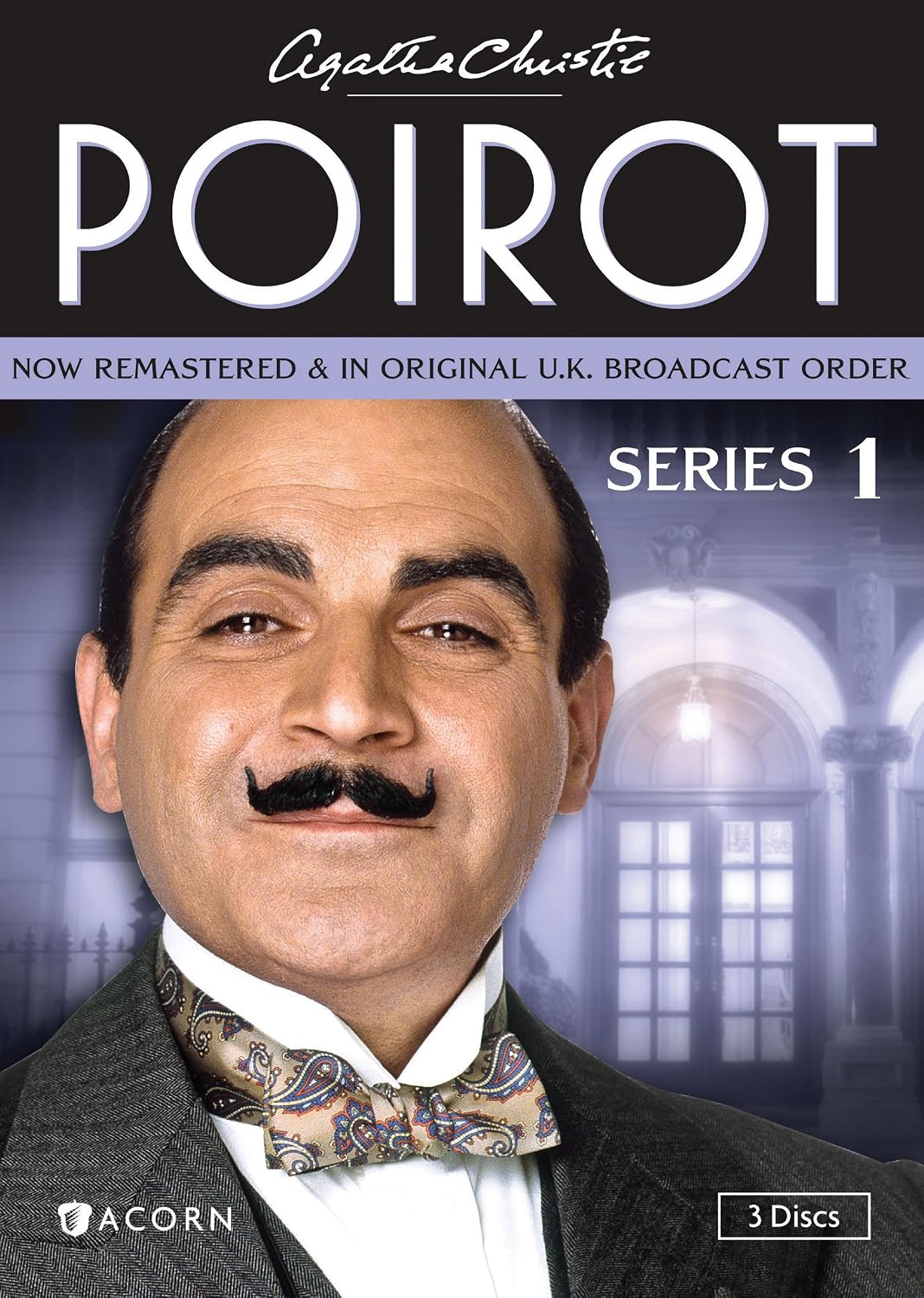
(Not Really a) Review: First Impressions of Poirot

When I looked for period dramas I haven't seen yet, this series appeared in almost every list. At first I was reluctant to start a series where every episode is a different story. Now I've finally got around to starting it, and I wish I'd done it earlier.

Poirot (also called Agatha Christie's Poirot; apparently someone thought there are so many characters named Poirot that viewers might think it's based on some other author's works) is a long-running series that adapts all of Agatha Christie's stories about the title character. Yes, all of them. Unsurprisingly it lasted over twenty years, from 1989 to 2013.

I've never read any of the Poirot novels, and my only previous knowledge of the character was from Murder on the Orient Express. So while I know every episode is about Poirot solving a mystery, I don't know anything about the cases. Turns out that's a good thing. I've watched the first four episodes of the first series, and every time I waited with bated breath to learn whodunnit and why they did it. Only once have I correctly guessed who the criminal is before the case is solved.

I love almost everything about this series. It's unexpectedly funny; Hastings' obsession with tennis and the running joke about Poirot's uncomfortable shirt collars are just two of the things that made me laugh. The cases themselves always end with an unexpected solution. And of course for period drama fans there's the 1930s setting. So I can safely say that this is one series I'll keep watching.

Wednesday, 24 June 2020

Review: Kingdom Season 2

I finished this series last week. If I tried to review it then the post would have been nothing but incoherent screaming. So I left it until now, when there's a chance of more coherency and less screaming.

The opening credits and title card are exactly the same as the first season's. Quite disappointing. I thought there might be a few changes at least.

Far, far too many series experience a dramatic decrease in quality in their second season. I braced myself for that to happen in this case. The most I hoped for was something of similar quality to Return to Cranford: just average, somewhat disappointing, but not atrocious.

Turns out I was wrong. It's every bit as good as the first season. In some ways it might even be better.

The first episode picks up where the last one left off: with Lee Chang, Mu Yeong and Yeong Shin facing a horde of zombies in one place, while Seo Bi and Beom Pal are trapped by more zombies somewhere else. From then on the plot follows their attempts to end the plague and confront the people whose actions created the zombies.

Each episode found new and exciting ways to terrify or nauseate me. I thought nothing could be more reprehensible than Yeong Shin tricking dozens of people into cannibalism, until Queen Consort Cho came along and proved me wrong. I also thought nothing could be more gruesome than the zombie attacks in the first season. That tongue-eating scene proved me wrong. Just thinking about it still makes me shudder 😰

Never has any series given me as many near-heart-attacks as the last episode does 😱 I spent most of the second half torn between wanting to watch it and wanting to hide behind the sofa. The epilogue is the most chilling part of all. Once again it ends on a cliffhanger. Unfortunately there's no third season yet. So we're left to wonder if another king is going to become a zombie, and why in the world anyone would deliberately unleash the plague.

I think the best way to describe my feelings about this series is by saying I desperately want season three and I'll be furious if we don't get it. Sure, Kingdom scares the hell out of me, but I still want more!

Is it available online?: On Netflix, probably.

Rating: 8/10.

Wednesday, 10 June 2020

Review: Kingdom (2019) Season 1

Lately I'm watching and reading an unusual amount of horror. Some so-called horror films and books aren't scary at all. Others are. This is one of the ones that are.


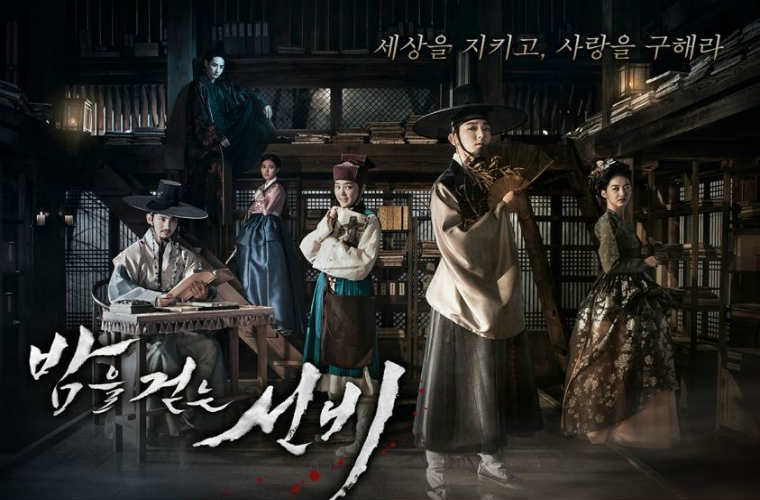
Kingdom (킹덤 or Kingdeom in Korean) is a 2019 period drama/horror K-drama based on the webcomic The Kingdom of the Gods. I haven't read the webcomic so I don't know how accurate an adaptation it is.

I didn't recognise any of the actors, so on to the plot.

No one is allowed to see the king. The queen claims he has smallpox. Crown Prince Lee Chang suspects something more sinister is happening. He goes to find a physician who may be able to tell him what's really wrong. Unfortunately he arrives just in time to be caught up in the zombie apocalypse -- and his father has already become a zombie.

This is the shortest Asian drama I've ever seen. It has only six episodes, each one less than an hour long. Yet so much happens in it that it feels much longer. And unlike some series the characters' bad decisions actually make sense. Far too often I see characters in horror stories doing the worst possible thing for the stupidest reasons. Here, Beom-pal thought removing the corpses was the best thing to do for obvious reasons. In any other story he'd have been right. It's just a pity he didn't know he was dealing with zombies. Same goes for most of the other characters. (Except that imbecile who brought a zombie onto the boat. That's near the top of the "worst decisions ever made in horror stories" list 😒)

Only two things irk me about it. One, the plague is caused by a plant. As I've said before, I prefer horror stories that don't explain where the monsters come from and don't have mundane explanations when supernatural ones would do. Two, the first season ends with a cliffhanger. Our heroes are facing a horde of zombies, their plan has failed, they're in mortal danger... and that's where the last episode ends. It was frustrating enough for me, and I started the first episode of season two almost immediately after finishing it. I can only imagine how awful that must have been for people who watched it before the second season aired.

Overall, though, this is one of the best -- and most terrifying -- horror series I've ever seen.

Is it available online?: I'm pretty sure it's on Netflix.

Rating: 8/10.

Sunday, 24 May 2020

Review: Nirvana in Fire

Who'd have thought? There are now four series I rate 10/10!

Some series require very little thought; I know them so well or they have such simple plots that they're easy to follow without paying attention. This is definitely not one of them. You need to concentrate on every minute of this series to fully understand how amazing it is. I've seen it four times and still keep finding things I missed.


Nirvana in Fire (琅琊榜/Láng Yá Bǎng, literally "Lang Ya List") is a 2015 Chinese series based on the novel of the same name by Yan Hai. It was followed by a 2017 sequel. (I watched the first five episodes of the sequel. Let's just say it's a fine example of why sequels can be very bad things. It's missing everything that made the first series so good.)

I only recognised three actors:
Hao Feng Cheng (Zhang Wenzheng in General and I) as Xiao Jingrui
Lei Wu (Yang Ping in Shadow 2018) as Fei Liu
Yu Jian Zhang (Pian Feng in Ice Fantasy) as Lie Zhanying

At first the story seems simple enough. Twelve years before the series begins, an army was massacred because they were falsely accused of treason. Mei Changsu was one of the few survivors. Ever since he's been planning his revenge. Now he's come to the capital to expose the corruption in the royal family, put his childhood friend Jingyan on the throne, and finally get justice. In the process he meets his former fiancée Nihuang again, who figures out his true identity very quickly. Unfortunately, she doesn't know he's secretly dying of poison.

Mei Changsu/Lin Shu/Su Zhe

Nihuang

Jingyan

Of course it's a lot more complicated than it sounds. Keeping track of who's who was a nightmare the first time I watched it. Just about everything will be important later. Even a book or a throwaway remark. You probably won't be able to understand the whole story unless you watch the series at least twice. Luckily it's the sort of series that you want to rewatch. Over and over and over. Even though it tears your heart into shreds repeatedly.

At least it has funny and heartwarming moments to distract from the tragedy. Fei Liu is one of the far too few child characters who are adorable without being annoying. Meng Zhi is basically part of the audience, watching, commenting on, and being confused by the schemes of all these geniuses. And Consort Jing is a strong contender for the title of "most amazing character in the entire series".

I avoided spoilers as much as possible, yet about half-way through I began to sense it wouldn't have a happy ending. I hoped and prayed I was wrong. Then the final episode arrived and proved me right. No matter how many times I see it, that damned last episode always leaves me a sobbing mess 😭

This isn't a series you can watch just for fun. You have to pay attention to basically everything. But it's one of the best series I've ever seen, and I expect I'll soon watch it a fifth time.

Is it available online?: Yes, on YouTube with English subs.

Rating: 10/10.

Sunday, 3 May 2020

(Not Really a) Review: The Three K-dramas I've Watched So Far

As you probably know by now, I've watched several Chinese dramas. Korean dramas, on the other hand, are a rabbit hole I haven't really fallen down yet. Here are my thoughts on the three dramas I have seen.


Goblin (also called Guardian: The Lonely and Great God) is one of the most famous K-dramas ever made. It's also the first one I watched from beginning to end. My thoughts: ...well, it's certainly good. At times it's heartwarming, at times it's depressing, and some parts of it made me roar with laughter.

There's just one problem. The far-too-large (and too obvious) age gap between the main couple. I simply can't ship an immortal man with a girl who's still in high school. Not only that, but their interactions feel far more friendly/familial than romantic. I would have enjoyed the series more if it had removed the romance and instead focused on the zany antics of the immortal goblin and the grim reaper who somewhat reluctantly become housemates.

Rating: 7/10.


Scholar Who Walks the Night is based on the manhwa of the same name (which I haven't read yet). If it stays close to the source, then the manhwa isn't very good. If it doesn't, then the adaptation isn't very good. Basically, it's about vampires. In Joseon. Fighting over who gets the throne. Insane though that premise is, it could have been turned into something quite good. Unfortunately most of the series is silly and/or boring.

Ironically the best part of it is the villain. I fast-forwarded each episode until I found Gwi's next scene. He's a manipulative, despicable monster, but he's much more interesting than the heroes. I was honestly disappointed when he died.

Rating: 4/10.


The King in Love (also called The King Loves) is based on the novel of the same name, which in turn is loosely based on historical events. Verdict: yet another series with a clumsily shoehorned-in love triangle. The historical and political part of the story is interesting. But at least twice in every episode the plot comes to a screeching halt while Won, San and Rin angst and sulk about their romantic woes.

By far the worst part is the ending. We never find out how Rin survived that fall. I'd just accepted he was dead when suddenly he reappears without a word of explanation. There went my suspension of disbelief 😒

Rating: 6/10.

Wednesday, 29 April 2020

Review: The Longest Day in Chang'an

Every so often you come across a good series that's just too long. I suppose I should have expected it, considering the title. But seriously, forty-eight episodes (mostly) covering a single day?!


The Longest Day in Chang'an is a 2019 Chinese drama based on the novel of the same name by Bo Yong Ma. Unlike most Chinese period dramas, the setting is apparently very historically accurate. (The plot, on the other hand, is fiction. Though many of the characters were real people.)

I only recognised one actor, and he's one of the last people I expected to see in a Chinese drama:
Djimon Hounsou (Korath in Guardians of the Galaxy) as Ge Lao

On the surface the plot seems simple enough. A group of terrorists sneak into Chang'an, capital of the Tang dynasty, a day before the Lantern Festival. Their goal is to blow up the Lantern Tower and kill the emperor -- and hundreds of other people. Li Bi, head of the Peacekeeper Corps, recruits Zhang Xiao Jing, a condemned criminal, to help him find the terrorists.

Li Bi

Zhang Xiao Jing

Of course, it's a lot more complicated than that. A story that could have been told in about thirty episodes is stretched out to fill forty-eight. Unfortunately the result is that it frequently drags. I had to keep reminding myself that most of the events were happening in a single day. It felt more like the series covered at least a week. Until approximately the last ten episodes there was very little sense of urgency because everything was happening so darn slowly.

What's even worse is the placement of the flashbacks. They interrupt the story right when events are starting to speed up. Picture this: Long Bo and his cronies have placed explosives in the Lantern Tower. Li Bi is held hostage there. Zhang Xiao Jing is still trying to find the terrorists. Then the next episode leaves them hanging (literally, in Li Bi's case) and is almost entirely a flashback. My response was incoherent rage. Seriously?! They end an episode with a cliffhanger and then don't resolve it in the next episode? 😠

The series is unexpectedly dark and gory, especially for a C-drama. When I started it I never thought it would include nightmarish things like Tan Qi being buried alive or Yu Chang cutting off her own arm 😱

Overall it's a fairly good series. All the actors do an excellent job, and the cinematography is incredible. I enjoyed it a lot. I just would have enjoyed it more if it was shorter, and if they'd handled the flashbacks better.

Is it available online?: The first three episodes are on YouTube. The whole series is on Viki, and apparently also on Amazon Prime. (Currently only the first six episodes are available to the general public on Viki. You need to be a paying member to watch the rest of it.)

Rating: 6/10.

Wednesday, 25 March 2020

Review: The Magnificent Century Season 1

It took me ages to make any progress with this drama. At last, after many breaks when I just couldn't be bothered watching it, I've decided to drop it. Here are my thoughts on what I did watch, and why I lost interest.


The Magnificent Century/Muhteşem Yüzyıl is a Turkish series that aired from 2011 to 2014. It was followed by a sequel, The Magnificent Century: Kösem, in 2015.

I didn't recognise any of the actors, so on to the plot.

The series revolves around Alexandra/Hürrem, starting when she's kidnapped and forced to become one of the Sultan's concubines. She eventually becomes Suleiman's legal wife, in spite of the other concubines plotting against her.

As I said in my first impressions of the series, the main problem with the story is how it pretends a deeply dysfunctional relationship is a grand romance. (I have no idea what happened historically; this is entirely the series' highly fictionalised version of events.) Alexandra loses her parents, her fiancé, her home, her language, her religion, and even her name when she's brought to the palace, but she's only upset about any of this for about half an episode. Then she falls in "love" with Suleiman and starts plotting to gain his favour like all the rest of the concubines.

In any other series that would be the grim, depressing tragedy of a woman who has everything taken from her and has no choice but to adapt to her new "home" to survive. This series pretends everything's just fine and dandy and look, Suleiman really loves Hürrem even though she's just one of God-knows-how-many concubines! Not to mention that part where he slept with Hürrem's former friend while Hürrem was giving birth to his child. There's no way to view that as a romance. It's more disturbing than some true crime documentaries I've seen.

The series doesn't even have the benefit of being interesting. It's incredibly repetitive. Every episode was another rehash of the "Mahidevran plots again Hürrem" story. Nor could I sympathise with any of the characters. They're all doing their best to destroy their own and everyone else's lives, and after the first two episodes all of them blurred together.

So, after eight painful and infuriating episodes, I've given up this series and have no intention of ever returning to it.

Is it available online?: It's on YouTube. I can't be bothered giving a link.

Rating: 1/10.

Wednesday, 18 March 2020

Review: The Terror (2018)

I watched this series last year and meant to review it after finishing it. Of course, being the scatterbrain I am, I promptly forgot all about it until now. I known I've forgotten a lot about the series, but I remember enough to give my general thoughts on it.


The Terror is a 2018 period drama/horror miniseries, based on the 2007 novel of the same name, which in turn is loosely based on Franklin's lost expedition. I haven't read the book, so I don't know how closely it sticks to it. A second season aired in 2019; it was unrelated to the novel and set in an entirely different place and era.

I only recognised a few actors:
Jared Harris (King George VI in The Crown) as Crozier
Tobias Menzies (Prince Philip in The Crown season three) as Fitzjames
Ciarán Hinds (Edward Rochester in Jane Eyre 1997) as Franklin
Alistair Petrie (Major Gordon in Cranford) as the doctor
John Lynch (Nemo in Bleak House 2005) as Bridgens

The series starts with the expedition's two ships, Terror and Erebus, getting stuck in ice. Things quickly go from bad to worse when a monstrous bear starts hunting the crew -- and an equally monstrous member of the expedition starts killing those lucky enough to escape the bear.

I have to admit, it was a chore to stay interested in the series. The very first scene makes it clear almost everyone's going to die. That removed all suspense at once, and all that remained was to see how they died. It also meant I didn't care for any of the characters. What's the point of getting attached to people who you know will die horribly? (And very few of them are likeable anyway.)

After reading the plot summary I expected the Tuunbaq would be the main villain. Well, it's certainly one of them, but Hickey is arguably even worse. Not to mention the Tuunbaq has surprisingly little screentime. And its death is a real anticlimax. The rest of the series built it up as some supernatural monster that can eat souls, then it... eats Hickey and chokes to death. Or maybe he poisoned it; he was certainly vile enough. Either way, that left me wondering just what it was supposed to be. A real animal? A spirit? Some weird combination of the two?

The series has its good moments. (Since it's a horror series, "good" means everything from "suspenseful" to "terrifying".) The Tuunbaq's attacks stand out. I would probably have been more interested if it hadn't revealed the characters' fates in the first five minutes. As it is, it's not one of my favourites, and I'm not likely to watch it again.

Is it available online?: Not as far as I know.

Rating: 5/10.

Sunday, 15 March 2020

(Not Really a) Review: First Impressions of The Magnificent Century

After several years of thinking "I want to watch this" and promptly forgetting all about it, I've finally managed to start this series.


The Magnificent Century is a Turkish historical fiction series based on the life of Hürrem, wife of Suleiman the Magnificent. This is the first time I've ever watched a Turkish drama. The first thing that struck me was how long the episodes are. Episode one alone is over one hour and forty minutes. I've seen films that aren't that long. Somehow I suspect it will take me ages to finish the series.

To be honest, I've never given much thought to Turkish history. What I knew about it before this series could be boiled down to three things: the Turks fought Dracula (the historical figure, not the fictional vampire named after him); whoever got the throne murdered all his brothers; and Turkey has a habit of committing genocide and lying about it. Even if the series isn't historically accurate, it still taught me about the sultanate of women and the existence of people I'd never heard of before.

Even if the story is sometimes predictable, the series is worth watching for the costumes alone. (Fun fact: I only learnt it existed by seeing pictures of the costumes on Pinterest and Tumblr.)

I've only watched the first episode, and I can already tell what my biggest problem will be with the story. Alexandra, later renamed Hürrem, was kidnapped from her home, taken to a foreign country, and made one of Suleiman's concubines against her will. It looks ominously like the series is going to portray their relationship as some grand romance. No, no, no. Setting aside whatever happened in real life, the series' version of events is disturbingly reminiscent of Stockholm syndrome.

So far I'm ambivalent towards this series. It's not utterly atrocious, but I doubt it will ever be one of my favourites. I'll write a longer review when (if) I finish it.

Wednesday, 29 January 2020

Review: The Haunting (novel)

Usually a title gives clues to a book's genre. Not this one. Despite what you might think, this book is not a horror story. It's barely even a ghost story.


The Haunting is a 2011 novel by Alan Titchmarsh. It's much more a mystery novel than a ghost story. It has two plots, set two hundred years apart: the mysterious disappearance of a servant in the early 1800s, and a man researching his ancestors in 2010.

Like most of the books I read at work, I picked this one up mainly because it was there and I had nothing else to read. I expected a spooky mystery with plenty of ghosts. Well, there is a mystery. And there is a ghost -- though it appears so rarely that it might as well not be there at all. But "spooky" is the last word I'd use to describe it.

The most interesting part of the novel is the historical plot. The modern-day plot is frankly dull. I lost interest and skipped most of it. I cared much more about learning what happened to Anne than about reading yet more of Harry's angst. But even the historical plot becomes predictable and maudlin towards the end. As for the twist at the end, I saw it coming as soon as I realised Harry would inevitably make some discovery about Merrily Flint's parents. The least believable part was how almost everyone in the modern-day plot was somehow related to the people in the historical part. It was like reading a Dickens novel without any of the things that make Dickens novels so good.

Honestly I would have liked this book better if it had a different title. A rose by any other name may smell sweet, but a book with a misleading title is always going to be disappointing. If the title hadn't implied this was a ghost story I wouldn't have expected one.

There are worse books. There are also better ones. I didn't hate this book, but I won't reread it.

Is it available online?: No.

Rating: 4/10.

Wednesday, 15 January 2020

Review: Goodbye My Princess

What an awful week this has been. It was so bad I nearly decided not to bother writing a review today. But I recently finished this series, so I might as well review it now.

This is the first C-drama I've watched that's a tragedy. Most other series have at least a bittersweet ending. This one's ending is entirely bitter. Strangest of all, some people still call it a romantic comedy.


Knowing what to call this drama is a puzzle. Remember how Ashes of Love had multiple titles? So does this one. It's called Goodbye My Princess and Eastern Palace in English, Dōng Gōng in Pinyin, and 東宮/东宫 (depending on whether you use traditional or simplified characters) in Chinese. Whatever you want to call it, it's a 2019 series based on the novel Eastern Palace by Fei Wo Si Cun.

I only recognised one actor:
Zan Jin Zhu (Jin Guangyao in The Untamed) as Zhao Shi Xuan

At first the series looks like a typical "character conceals their identity" romance drama. Princess Xiao Feng, our heroine, meets a man who claims to be a merchant. He's actually Prince Cheng Yin from a rival kingdom. They fall in love and get married. Happily ever after, right? Nope. Everything goes horribly wrong. Short summary of what happens next: Cheng Yin kills Xiao Feng's grandfather, Xiao Feng attempts suicide, both of them lose their memories, they fall in love and get married again, and Cheng Yin ruins everything again. "Happily ever after"? This series doesn't know the meaning of the words.

Now, a few words about the characters.

Xiao Feng

From the first episode Xiao Feng was my favourite character. She's so brave and she suffers so much that I spent most of the series hoping she would finally escape Cheng Yin. The last episode dashed those hopes. I still can't think of (SPOILER!) her suicide without tearing up 😭

Cheng Yin

One word: ugh. Cheng Yin is one of those characters who had the potential to be good, and instead became the villain. His love for Xiao Feng starts out cute and innocent. It very quickly becomes possessiveness and an obsession that refuses to let her go even when she tries to escape. I'm horrified but almost impressed at thoroughly he ruins her life and his own. Anyone can mess up a second chance, but it takes real talent to start again and then destroy everything the exact same way as the first time.

Gu Jian

At first I was basically indifferent to Gu Jian. Then they brought him back from the (almost) dead under circumstances utterly implausible even for Cdramas. I can believe he survived being stabbed. I can believe, with some more difficulty, that he survived being thrown off a huge cliff. But I cannot believe that he, a normal human in a non-fantasy series, survived both. As for his personality, he made so little impression that I can only say he'd have been better for Xiao Feng than Cheng Yin was. (Which really isn't saying much. Just about anyone would be better for Xiao Feng than Cheng Yin.)

Se Se

Is it possible? A character who I loathe as much as Cheng Yin? I certainly didn't think any character could manage it. Cheng Yin disgusts me so much that he's on a level very few characters can stoop to reach. Yet Se Se does just that. She's as obsessed with Cheng Yin as he is with Xiao Feng. That's bad enough (what self-respecting woman could ever consider Cheng Yin a suitable husband?!), but she also makes Xiao Feng's life even more miserable than it already was.

Shi Xuan

If ever there was a case of wasted potential... Zan Jin Zhu was so good in The Untamed (and by "good" I mean "excellent"; he went from adorable to downright terrifying in no seconds flat) that I was delighted to learn he was in this series. I expected he would play a major character, or at least an important one. Instead Shi Xuan has very few scenes and virtually nothing to do. Most disappointing 😞

The empress, proof that historical accuracy can be a very bad thing.

When the empress first appeared I had to stop the video and stare for a minute. All I could think was "What the hell is that make-up????" So I had to consult Google. Turns out her... unique... appearance is based on a style of make-up worn during the Tang dynasty. Goodness knows why someone chose that style for the empress; the series isn't even set in the Tang dynasty.

There are a few things that annoyed me about the series. One was the existence of the River of Forgetfulness. There are no other fantasy elements to be seen, but there really is a river that can make people forget things? That stretched my disbelief almost to breaking point. Another was the Shuobo subplot. It contributes very little to the main plot, except to make life even harder for Xiao Feng. But fortunately those annoyances are minor things.

If you want a fluffy romance with a happy ending, this is definitely not the series for you. If you don't mind a series that's frequently depressing and has an absolutely heartbreaking end, you might enjoy this one.

Is it available online?: Yes, on YouTube with English subtitles. (There are two versions on YouTube; a shortened 52-episode one, and a longer 55-episode one. I watched the longer version.)

Rating: 9/10.

Sunday, 5 January 2020

Review: Murder on the Orient Express (1974)

Welcome to the first review of 2020! Most people, for obvious reasons, watched this version before the 2017 one. Many insist this is the better adaptation. Do I agree with those people? ...Yes and no.

I prefer this title-card to the 2017 film's. It's much more fitting for a period drama.

This is the first film version of Agatha Christie's novel. Incidentally, there were only two adaptations of her works that she liked, and this was one of them.

Like the 2017 film, this one has an all-star cast. Like many films from years before I was born, I recognise many of the names but haven't seen any of their other films. There were only two who I had seen before:
Ingrid Bergman (Alicia in Notorious 1946) as Greta Ohlsson
Sean Connery (Henry Jones Sr. in Indiana Jones and the Last Crusade) as Colonel Arbuthnot

The film starts with the kidnapping that sets the entire plot in motion. Unfortunately, the way it's filmed makes the characters' movements bizarrely puppet-like. People don't walk normally; they jump around. Most distracting.

Thank goodness the next scene is filmed more normally. There's no sign of Poirot solving a crime in Israel. (Was that an invention of the 2017 film?) We go straight to Poirot waiting for a ferry.

LOL at that poor man who tried to pronounce Arbuthnot's name 😄 The relationship between Arbuthnot and Miss Debenham is much more overt in this version. I wasn't expecting them to practically run at each other and start kissing.

The train station and the Orient Express itself are much less elaborate than in the 2017 film. Goats right next to the train? That's an accident waiting to happen!

Where are Health and Safety when you need them?

Mrs. Hubbard's complaints made me giggle 😄 Who wants ice in drinking water anyway?

For some reason Bouc is renamed Bianchi. I can't see why they made such an unnecessary change. And Poirot has another helper, Dr. Constantine. Apparently he was in the novel but removed from the 2017 film.

Like many films from the 70s (and 80s) the colour is somehow... "faded" isn't quite the right word. It's as if there simply are no bright colours in the film. And the picture is not quite grainy, but also not as clear as in more recent films. (Or older films, for that matter; I've never seen this in films from the 40s and 50s.) It must be a problem with the cameras used at the time; it also pops up in Sense and Sensibility (1971) and Pride and Prejudice (1980). Quite a disappointment when compared to the 2017 film's beautiful visuals.

LOL at Ratchett running off under cover of darkness 😆 Poirot's confusion makes it even funnier! There's as much comedy in this as in the 2017 version. I laughed even harder at Poirot's alarm when he learns Mrs. Hubbard is too near him.

I think I prefer this version of how they discover the murder. The 2017 film only showed the tops of everyone's heads. Here we get to see their reactions.

Wait, Cassetti himself didn't kill Daisy? His underling did? I don't remember that in the other film. Unfortunately I've no idea which is closer to the book.

This version emphasises the urgency of solving the crime before the rescuers dig the train out. That's conspicuously lacking from the 2017 film. Actually I was surprised to realise there was any urgency.

My German is even worse than I thought 😓 I barely understood anything Hildegarde read to the Princess.

I didn't expect Poirot to give his speech solving the crime while still on the train. It seems incredibly cramped and crowded when compared with how the 2017 film portrayed that scene. And it's a much longer speech, too. There were times when I wondered if Poirot would ever get around to revealing who the murderers were. Incidentally, the Princess's outfit in this scene is the strangest thing I've seen this year.

Are those feathers part of her hat, part of her dress, or just a very odd scarf? (Whatever they are, they made me giggle during the least humourous scene in the film.)

The flashback goes into much more detail about how the passengers carried out the murder. I'm not sure what I think about them saying who they're avenging when they stab Ratchett/Cassetti. I can see why they do that, but it strikes me as just repeating what the viewer already knows.

The end is the part I like the least. The passengers don't seem at all upset by what they did, while in the 2017 film they're all clearly shaken and unsure they did the right thing. Poirot, after a brief line about wrestling with his conscience, disappears and we don't see his guilt over letting them go.

Overall I like both adaptations. I prefer the 2017 version's visuals and final scene, but I enjoyed this version too.

Is it available online?: Not as far as I know.

Rating: 7/10.

Wednesday, 18 December 2019

Review: Rob Roy (novel)

Believe it or not, it's possible (but very rare) for a book's plot to be implausible, contrived and poorly-thought-out... and for the book to still be interesting and enjoyable. This is one of those books.


Rob Roy is an 1817 novel by Sir Walter Scott. It's part of his Waverley series (which isn't a series in the modern sense; the books have similar settings and themes, not the same characters or stories). Several films with the book's title have been made, but none of them are actual adaptations of it.

Despite being the title character, Rob Roy isn't the narrator or the main character. He doesn't even appear until a quarter of the way through. Instead the main character is Frank Osbaldistone. A disagreement with his father leads to Frank being sent to stay with his uncle, while his sinister cousin Rashleigh takes his place in his father's business. Unsurprisingly Rashleigh turns out to be a crook, and Frank ends up fleeing to Scotland in search of some way to undo the damage Rashleigh's done. Along the way he meets and is helped by Rob Roy, and falls in love with the mysterious Diana Vernon.

The plot, as already mentioned, is by far the weakest part of the story. The characters aren't much better. Rob Roy is the only one who truly leaves an impression. Frank was so dull that I couldn't even remember his name after I finished the book. Diana is an interesting character but an unconvincing love interest. And Rashleigh, the main villain, is offstage (off-page?) for most of the story.

Most irritating of all are the frequent -- and lengthy -- paragraphs written entirely in a nigh-incomprehensible Scottish accent. You'd need a translator to understand half of what Andrew Fairservice says.

Yet in spite of all these drawbacks, I was surprised by how much I enjoyed this book. The story is so exciting that you hardly notice how contrived the events are. I knew at the start that it was going to end with Frank marrying Diana and Rashleigh getting his just desserts, but it was still entertaining to see how that happened.

If you don't mind wading through the elaborate prose (to say nothing of the Scottish accents) and just want to read a fun historical novel without too much plot, this is the book for you!

Is it available online?: Yes, on Gutenberg.

Rating: 7/10.

Sunday, 8 December 2019

Review: And Then There Were None (2015)

I have a confession to make, one that will amaze anyone who knows me in real life: I've never read any of Agatha Christie's books. Someone is probably thinking, "How can you be a bookworm and not read her books?" Good question. I want to read some of her books, but I've never got around to it yet. So I was one of the few people to watch this series with only a vague idea of the plot.


And Then There Were None is a 2015 miniseries adapted from the book of the same name by Agatha Christie. It's the first miniseries adaptation, but there have been at least four different film versions. I wrote this review while watching the series, so it's basically a list of my thoughts as I watched it.

There are several recognisable actors.
Anna Maxwell Martin (Esther in Bleak House 2005) as Mrs. Rogers
Charles Dance (Mr. Tulkinghorn in Bleak House 2005) as Wargrave
Burn Gorman (Mr. Guppy in Bleak House 2005) as Blore
Douglas Booth (Pip in Great Expectations 2011) as Marston
Sam Neill (Dr. Grant in Jurassic Park) as MacArthur
Miranda Richardson (Lady Van Tassel in Sleepy Hollow 1999) as Miss Brent
Aidan Turner (Kíli in The Hobbit) as Lombard

The opening credits are, not to put too fine a point on it, ugly. I hardly noticed any of the names at first. I was too busy trying to figure out what on earth those hideous green things were supposed to be. The first scenes aren't an improvement. The constant cuts between apparently-unrelated events left me wondering what the heck I was watching.

The series finds a creative way to introduce all the characters. We start with a woman being offered a job she didn't apply for -- something that would have warned most people there was something suspicious going on. Then we abruptly jump to letters being sent to other people, interspersed with those people going about their days. Creative, but confusing.

I like the music; it's suitably ominous. So is the incredibly bleak island the characters go to. What sort of island has massive cliffs in the middle of it?!

Is this an island or the Loch Ness Monster?

Imagine trying to write a tourist brochure for this island! An idyllic destination for anyone who likes to spend their holidays terrified of falling. If you don't have a fear of heights already, this place will give you one.

Ugh, the hideous green things reappear. Now I'm fairly sure they're supposed to be statues. Statues that look like the first attempts of a clumsy amateur statue-maker who made them while blindfolded 😒

What are those servants up to? At first I thought they were Mr. and Mrs. Owen in disguise. I'm trying very hard not to look up the book's plot, but the series takes ages to explain anything. At this rate I'll have to consult Wikipedia just to understand what's happening.

None of the characters are admirable, but Lombard stands out as a disgusting creep 😠

Love the scene where darkness literally covers the island! It's incredibly eerie, and the symbolism is obvious without being obnoxious.

The flashbacks to the murders are chilling 😨 I was wrong when I said Lombard's a disgusting creep. He's a complete monster 😱 I know enough of the plot to know most of the people on the island die. But I didn't expect the first death would happen so suddenly 😨

Episode two begins with two dead guests and two missing statues. (Thank goodness there are two less of those eyesores!) Sometimes this series feels more like horror than mystery. The way the camera lingers on the axe is honestly terrifying.

Some parts of the plot remind me a lot of Murder on the Orient Express. Most notably when everyone realises the killer is one of the guests.

As if the whole thing isn't creepy enough, the series just has to go the "dark and stormy night" route. Complete with lights going out, windows blowing open, and the moon going behind a cloud. And another murder, of course. Possibly the goriest yet 😱

Hiding a key and a gun in a bearskin rug? What a weird place to hide anything. Though I guess it worked; no one found the key. Yet.

It took me until the opening credits of episode three to realise that title card isn't just a mass of cracked statues; it's in the shape of the island and the house. Now I feel stupid for not noticing it earlier.

Someone clearly thought there wasn't enough horror in the series, so they showed some of the guests imagining their victims are in their rooms. I'm not sure if those are supposed to be hallucinations or if we're meant to believe they're actual ghosts. Either way, they're terrifying. Especially the hand in the sink 😨

Oh, for goodness' sake. A horror/mystery series is much better off without a romance subplot, but they just had to shoehorn one in here anyway. Not only does it interrupt the suspense, it's utterly out of place. And between the most despicable guest and the closest the series has to a main character, too. I don't know if it was in the book. Even if so, it should have been left out of the series.

What on earth? The bearskin rug came to life?! That had better be another hallucination 😒

I suspect the director wanted Lombard's death to be sad. The "romance" earlier only makes sense if you think it's meant to turn later events into a tear jerker. Unfortunately, Lombard was such a vile character that I didn't feel sorry for him at all. And the way Vera shrieked and hopped around just looked silly.

THE JUDGE WASN'T DEAD?????? And he was behind the whole thing? ...I should probably have guessed. Any character played by Charles Dance is practically guaranteed to be a villain.

The final scene is possibly the most disturbing in the whole series. Even if anyone finds all the bodies, they'll have no idea what really happened or who the killer was. Creepy.

Overall I quite enjoyed this series. I don't know how faithful it is to the book, but as a story in its own right it's fairly good. My main problem with it is how utterly despicable all the characters are. I know that's the point of the series, but I prefer stories with at least one relatively decent character.

Is it available online?: I doubt it.

Rating: 6/10.

Wednesday, 4 December 2019

Review: Belgravia (novel)

Happy December! I hope my readers had a far less stressful November than I did 😄


Belgravia is a 2016 novel by Julian Fellowes, creator of Downton Abbey. (Which does not bode well for its quality or historical accuracy.) Next year it will be adapted into a miniseries.

The main plot takes place in 1840s London. But it's shaped by events that happened years earlier, in Belgium shortly before the Battle of Waterloo. The story revolves around a scandal involving two very different families, and the different ways they try to deal with it or cover it up.

I started this book not expecting much. Everyone knows how Downton Abbey turned into a train-wreck, and honestly that "From the author of Downton Abbey" logo on the cover made me reluctant to read it. When I finished the first chapter I thought, "Well, it's not too bad so far. Might as well continue." I continued to read. I finished the book. And when I finished it I was left with a new conviction: Julian Fellowes is unable to write anything consistently good.

Belgravia, much like Downton, starts out a fairly decent period drama. It's not the greatest, but it's not absolute trash. I enjoyed the first two or three chapters. Then, like Downton, the quality deteriorates. Rapidly. Before long the plot became a shambling mess, the characters lost any realism they had, and I only read on to see how it ended. I skipped whole scenes to get to the resolution.

Surprisingly the book manages an unforeseen and actually interesting twist near the end: the discovery that the scandal didn't actually exist. Not in the way everyone thought it did, anyway. That was the only thing I didn't see coming. Everything else was predictable. A predictable plot isn't always a bad thing, but it's certainly not going to keep a reader interested for long.

The resolution of the villains' subplots is the part I hated most. John tried to murder Charles, and he gets off scot-free. All right, so he's in financial difficulties, but that's hardly any retribution for all his vileness. Susan outright gets rewarded for her sins. Oliver is an absolute idiot who stirs up trouble out of petty jealousy... and he gets rewarded too. Argh!

I can safely say I will never reread this book. And it's extremely unlikely I'll bother to watch the miniseries. There are far better period drama to read and watch.

Is it available online?: Not as far as I know.

Rating: 2/10.